

Working Out the Kinks
How a pseudo-scientific insult collapses trans life into fetish—and what it really reveals about fear and control


TL:DR
Autogynephilia was coined in the 1980s to pathologize trans women as fetishists. Mainstream science abandoned it, but the slur lingers because it’s politically useful.
The charge of narcissism and sexual deviance isn’t evidence—it’s projection. What it really reflects are cultural fears about gender, power, and control.
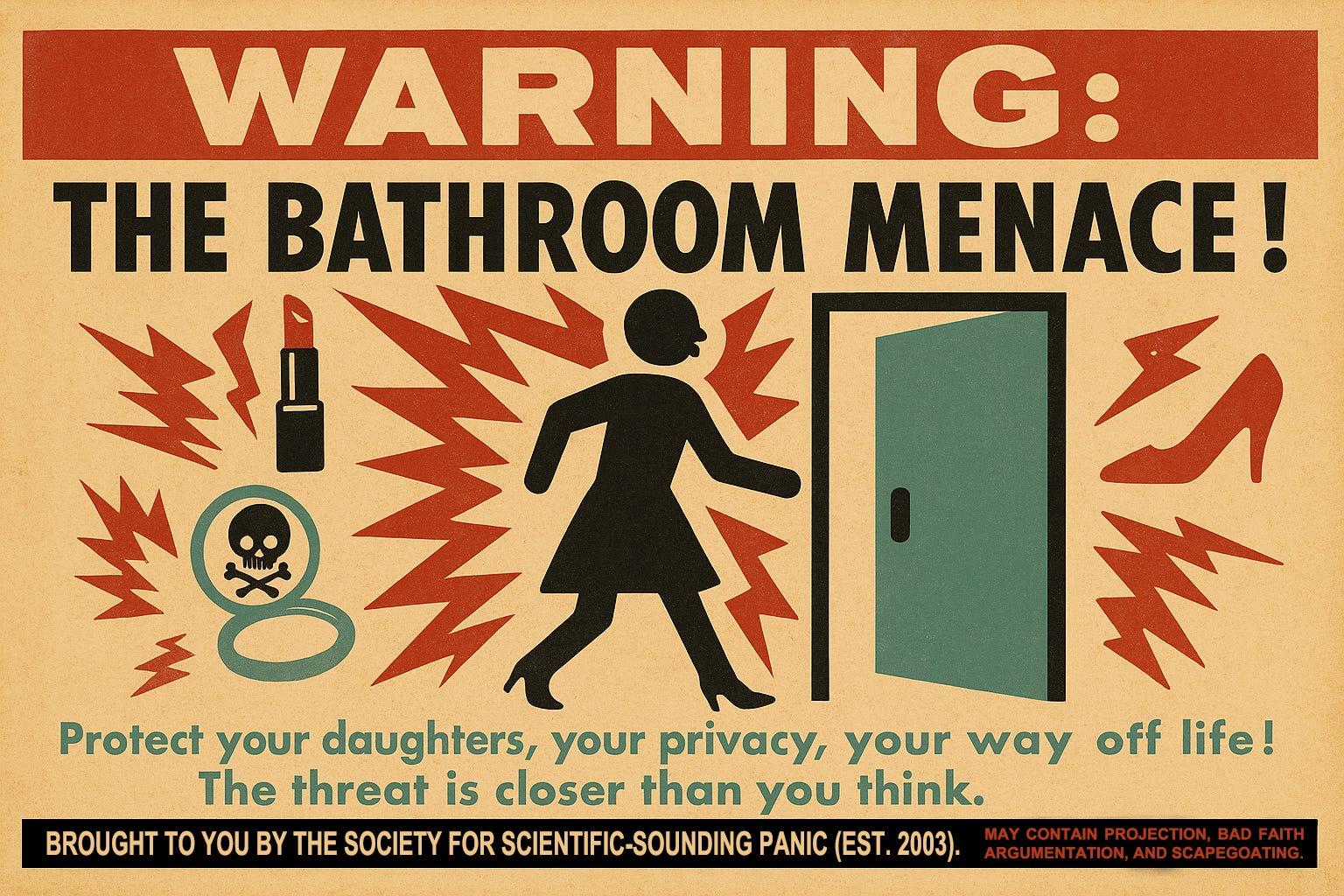
The obsession with “protecting women’s spaces” says less about trans women than about a fantasy life saturated with imagined violations—bathrooms, locker rooms, predators in lipstick.
Meanwhile, transition is not an erotic thrill but a life of grief, relief, fluorescent waiting rooms, and survival.
The real pathology isn’t in trans lives. It’s in the cultural need to explain us away—and in the machinery of scapegoating now turning slurs into state power.
Fashy Fetish Falsehoods
Every so often, someone decides to call me an autogynephile (AGP for short). The word sounds technical, even authoritative, but what it really means is: your gender isn’t real, it’s just a fetish. In this view, the years of grief, relief, and survival that shape my life collapse into a single explanation: I get off on imagining myself as a woman.
Which would be funny if it weren’t so tired. Transition has been many things for me—awkward joy, long stretches of despair, a grinding amount of paperwork, hours under fluorescent lights in waiting rooms. If this is supposed to be some grand erotic thrill, then it’s the least sexy kink I’ve ever heard of. I’ve met more arousing spreadsheets.
But the point of the term isn’t accuracy. It was never meant to describe lived reality. The goal is dismissal and erasure.
That’s why the insult always comes pre-loaded with a sneer. It isn’t aimed at truth but at credibility: if I can be framed as a fetishist, then nothing I say about my own life has to be taken seriously. I don’t get to be a witness to my own experience—I get reduced to a case study in someone else’s pathology. That’s the point: once my life is reduced to pathology, I stop being someone who can speak for myself and become someone who can only be spoken about. And once you’ve been rewritten that way, every detail of your life can be folded back into the script. My laughter, my pain, my politics—it’s all supposedly evidence of the same sick desire.
That’s the banal absurdity: the fantasy is charged with pornographic danger, while the reality is beige—forms, fluorescent lights, waiting rooms that smell like hand sanitizer. To call this fetish is to confess you’ve never been in the room with us.
The Toxic Trope of Transphobic Terminology
The term autogynephilia comes from Ray Blanchard, a Canadian sexologist in the 1980s. He proposed that there were two basic kinds of trans women:
“Homosexual transsexuals,” who were attracted to men and wanted to pass as women in order to gain male partners.
“Autogynephiles,” who were supposedly aroused by the thought of themselves as female, and whose transition was therefore driven by a kind of fetishistic obsession.
In short: pathetic sissies or perverts. That was the taxonomy.
Blanchard’s model was narrow, rooted in the particular clinical population he studied, and never gained broad acceptance in medicine or psychology. Decades of subsequent research have found that trans identity cannot be reduced to sexual orientation or arousal patterns. Mainstream science moved on.
But the idea didn’t disappear. Like phrenology or eugenics, it lingered on the margins—not because it was true, but because it was useful. To researchers and gatekeepers who wanted tidy categories instead of messy lives. To conservatives eager for a “scientific” veneer on their disgust. To internet trolls and self-styled “gender critics” looking for a pseudo-academic cudgel.
The theory thrived not in labs or clinics but in the din of culture wars, where a whiff of authority was enough to turn slander into citation. In that sense, autogynephilia was never just a medical idea—it was a political technology, a way of keeping trans women legible only as caricatures. The tactic is old: invent a pathology, attach it to the inconvenient group, and call it science.
And that’s why the word still circulates today, decades after its credibility expired. Once an idea is seeded into the public imagination, it doesn’t need evidence to survive. It just needs repetition, a ready audience, and the cultural machinery that thrives on turning fear into common sense.
Weaponizing a Weaksauce Worldview
Over the past two decades, autogynephilia has become a favorite cudgel in certain circles: “feminists” who view trans women as infiltrators, right-wing pundits who cast us as predators, anonymous trolls who thrive on medical-sounding slurs.
In debates over so-called “bathroom bills,” groups like the Heritage Foundation or the Family Research Council have explicitly leaned on the image of the male fetishist who “invades” women’s spaces. The argument is rarely phrased in Blanchard’s terminology, but the DNA is there: transition is framed as deception, desire as perversion, self-knowledge as delusion. Even J.K. Rowling, in her now infamous essay, leaned on the suspicion that trans women’s presence in women’s spaces was somehow rooted in sexual deviance.
Why the appeal? Because it’s a totalizing explanation. It doesn’t matter what a trans woman says about her experience. It doesn’t matter what history reveals about gender diversity across cultures, or what science shows about gender identity. If you begin with the assumption that she’s deluded and perverse, then every aspect of her life becomes evidence of pathology.
That’s the trick of the word. It’s less a diagnosis than a worldview.
The Nasty Narcissism of Nixing the Nonconforming
Built into the accusation of autogynephilia is the claim that trans women are narcissists: so obsessed with our fantasies that we demand the whole world play along. We’re cast as delusional, selfish, dangerous. In this story, transition isn’t survival, it’s performance. Our demands for dignity aren’t about life and death, they’re about stroking our fragile egos.
The irony, of course, is that this accusation requires a staggering level of narcissism on the part of those wielding it. To insist that one fringe theory from the 1980s trumps the testimony of millions of people, overrides millennia of cultural practices around gender, and invalidates contemporary science—that’s not just arrogance, it’s a refusal to share reality. It elevates ideological commitments over the lives of real people. It says, in effect: my theory matters more than your survival.
This is how narcissism works when it scales up from the individual to the cultural level. It isn’t about vanity or mirrors; it’s about the inability to imagine anyone else’s perspective as legitimate. It’s a closed loop of certainty, a circuit that interprets every contradiction as proof of delusion on the part of others. Once that loop is in place, violence not only becomes thinkable—it becomes righteous. If trans women are only acting out a fetish, then restricting our rights is framed as tough love, a moral correction. If trans women are recast as toxic men, driven by sexual compulsion to invade women’s restrooms and locker rooms, then harassment, exclusion, and even physical assault can be framed as self-defense.
And this is where the accusation of narcissism bleeds into power. It’s not simply that trans people are accused of being self-absorbed; it’s that our accusers position themselves as selfless protectors of society. Their own certainty—untouched by evidence, history, or testimony—becomes not hubris but heroism. That inversion is what makes the accusation so dangerous: it mobilizes violence under the banner of virtue. Which is some fashy shit.
That inversion—casting domination as protection—has always been the calling card of supremacy.
Projection, Pornography, and the Policing of Pee
Nevertheless, there is no credible evidence that trans women as a group are motivated by sexual fetish. There is also no evidence that we are more dangerous than anyone else. Actually, the opposite is true; study after study shows trans people are far more likely to be victims of harassment, assault, and homicide than perpetrators of harm.
Statistics only capture part of it. The reality for me is much more mundane, and much scarier: I’m always anxious when I need to pee or poo in public. I’ve been accosted more than once—twice by men who decided to police my presence, once by a drunk woman who’d been hitting on me earlier in the night. When she didn’t like my refusal, she followed me into a two-stall bathroom, flung open the door, and started screaming at me.
Whenever I go out with my partner, she scouts the restroom situation. If it’s gendered and the vibe feels unsafe, she’ll go in with me. If the space is queer-affirming, maybe I’ll risk going alone. Every decision to pee is a negotiation. But it is better than the alternative.
When I’m told to “just use the men’s room,” the joke writes itself: pretend my body belongs where it’s most at risk, so that transphobes don’t have to feel the sting of their own discomfort. That’s not a solution—it’s the logic of domination in miniature: my dignity and safety offered up so their world can stay tidy. And that’s the point—it’s not safety they want, it’s spectacle.
And yet the cultural imagination refuses to let go of its preferred storyline. Politicians and pundits pushing bathroom bills lean on the same recycled image: “men in dresses” lurking in women’s restrooms. Mainstream headlines may dress it up as a policy debate, but the specter they amplify is always the same—trans women cast as predators hiding in plain sight. Online forums spin out endless stories about locker room invasions, about predators in shabby drag. These images are not drawn from empirical reality—they are fabricated scripts, played on repeat until they feel inevitable.
And they aren’t just organic fantasies. They’re being manufactured and amplified. Conservative PACs and think tanks have spent millions on ads about “men in women’s sports” and “protecting our daughters.” State politicians stage press conferences about bathrooms or drag shows because they know fear is a winning campaign strategy. The myth of the predatory trans woman has been test-marketed, funded, and deployed as one of the most effective tools in the reactionary playbook.
The persistence of these fantasies tells us something important: the fear isn’t about what trans people do, but about what others imagine us doing. This is projection. Consequential projection. In case you aren’t familiar with the technical definition of the word, projection is the psychological trick of attributing your own impulses or anxieties to someone else. In politics, it works even better: your fear becomes my alleged crime, your obsession becomes my supposed desire. You imagine me as predatory, and suddenly my existence justifies your surveillance, your laws, your violence.
The specter of the predatory trans woman says less about trans lives than it does about the fears, obsessions, and fantasies of those who conjure her. It is a pornography of anxiety—graphic, repetitive, and fixated on violation. And like all pornography, its danger isn’t in its fantasy alone but in how that fantasy is consumed and acted upon. A steady diet of imagined trans perversion creates the conditions where repression feels protective, where cruelty feels necessary. The pornography here is not ours—it belongs to those who consume and circulate it, those who confuse their fantasies with reality and call it safeguarding.
Stale Slur to State-Sanctioned Scapegoating
So what does autogynephilia really describe? Not trans women. Not our desires, our struggles, or our joys. It describes a cultural knot, a kink in the fabric of how society handles difference. A bad theory that refuses to die because it meets a need: the need to project fear outward rather than face it within.
And we can see that need escalating. Just last week, Andrew Bailey—best known for trying to strip trans Missourians of healthcare—was elevated to deputy director of the FBI. The federal government announced it will cut off gender-affirming care for millions of employees and their families while mandating coverage for “faith-based counseling.” These aren’t abstract fears. They are projections translated into policy, fantasies hardened into law. The myth of the predatory trans woman is not just shaping bathroom debates anymore—it is being written into the operating manual of state power.
That is what makes the accusation so dangerous. It isn’t just a slur. It’s a story that justifies dismantling rights, a fantasy that rationalizes cruelty, a projection that now directs the machinery of government. That’s the work scapegoats have always done: turn social anxiety into a target, a story that can be punished instead of understood. Autogynephilia survives not as science but as myth, and like every myth that casts difference as deviance, it is most lethal when believed by those in power. Because every myth that works as scapegoating does the same thing: it feeds collective fears by sacrificing the vulnerable.
Scapegoats aren’t chosen because they’re guilty—they’re chosen because they’re useful, because their sacrifice oils the gears of control.
And here’s the cruel trick: projection doesn’t just distort how others see us—it reshapes how society sees itself. Every time a government frames trans existence as pathology, it tightens the boundaries of what counts as “normal,” “safe,” or “real.” The target may be trans women today, but the machinery it builds will be turned on anyone who unsettles the dominant order. Fear of us becomes practice for broader repression. Not to kink-shame, but it is almost like supremacy is their wild fantasy and oppressing others is their kink.
The pathology isn’t in my existence. It’s in the compulsion to explain me away—and in the machinery now being built to erase anyone who doesn’t conform. Erase me today, erase someone else tomorrow. That’s how scapegoats work—they’re never the endgame, just an opening act.
I continue to be amazed at your ability to capture your reality and the pathology of our society. Our country has always been this way but has typically been less blatant in its expression. I find that I ache with you as you tell us about your daily experiences. I hope your truth (which is truth for all of us) will be heard by those who need to hear. What a long, painful road to bending the arc of the universe toward justice.